INDEPENDENT PROJECT / LIVE MUSIC DISCOVERY
Midnight
Jukebox.
Every song takes you somewhere.
A late-night listening room with direct routes into eras, feelings, and handmade mixtapes.

01 / THE EXPERIENCE
Start with a feeling.
A familiar song can bring a whole moment back.
Midnight Jukebox is an independent music-discovery site built around memory, mood, and late-night listening. Its homepage is an illustrated room with records, a stereo, warm lamps, a rainy city, and a glowing jukebox.
Three prominent choices give that atmosphere a practical purpose: Go Back in Time, Feel Something, and Surprise Me. Featured mixtapes offer another entry, while About explains the experience within the homepage.
The design challenge is to make a nostalgic world easy to navigate: give listeners an evocative starting point, then a clear action that brings them to music.
02 / DISCOVERY JOURNEYS
Choose an era.
Choose a mood.
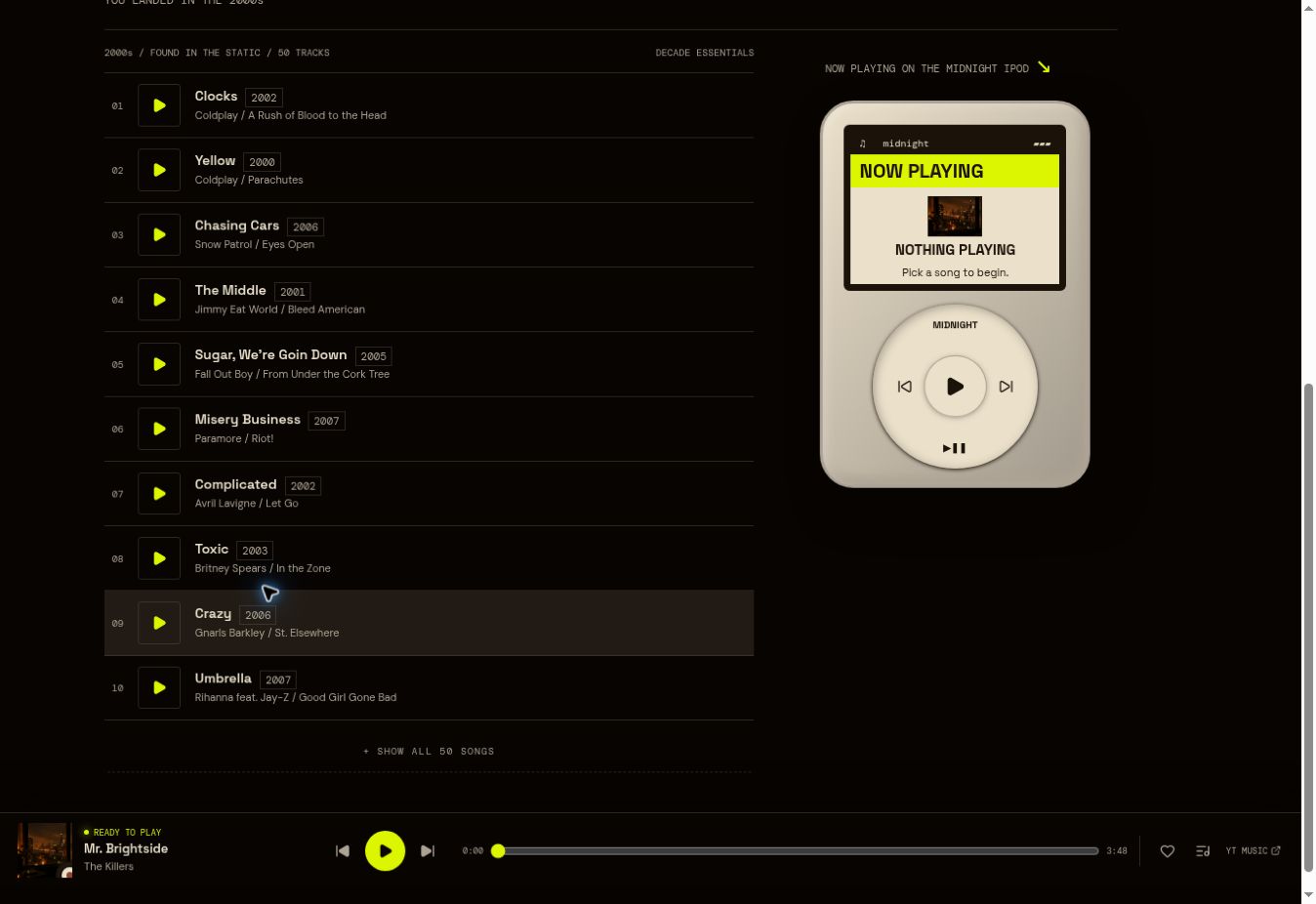
Go Back in Time opens a dedicated page with six decades: 1970s, 1980s, 1990s, 2000s, 2010s, and 2020s. Choosing a decade reveals song results on the same page. Track rows include a title, year, artist, album, and play action, with an option to show the full list.
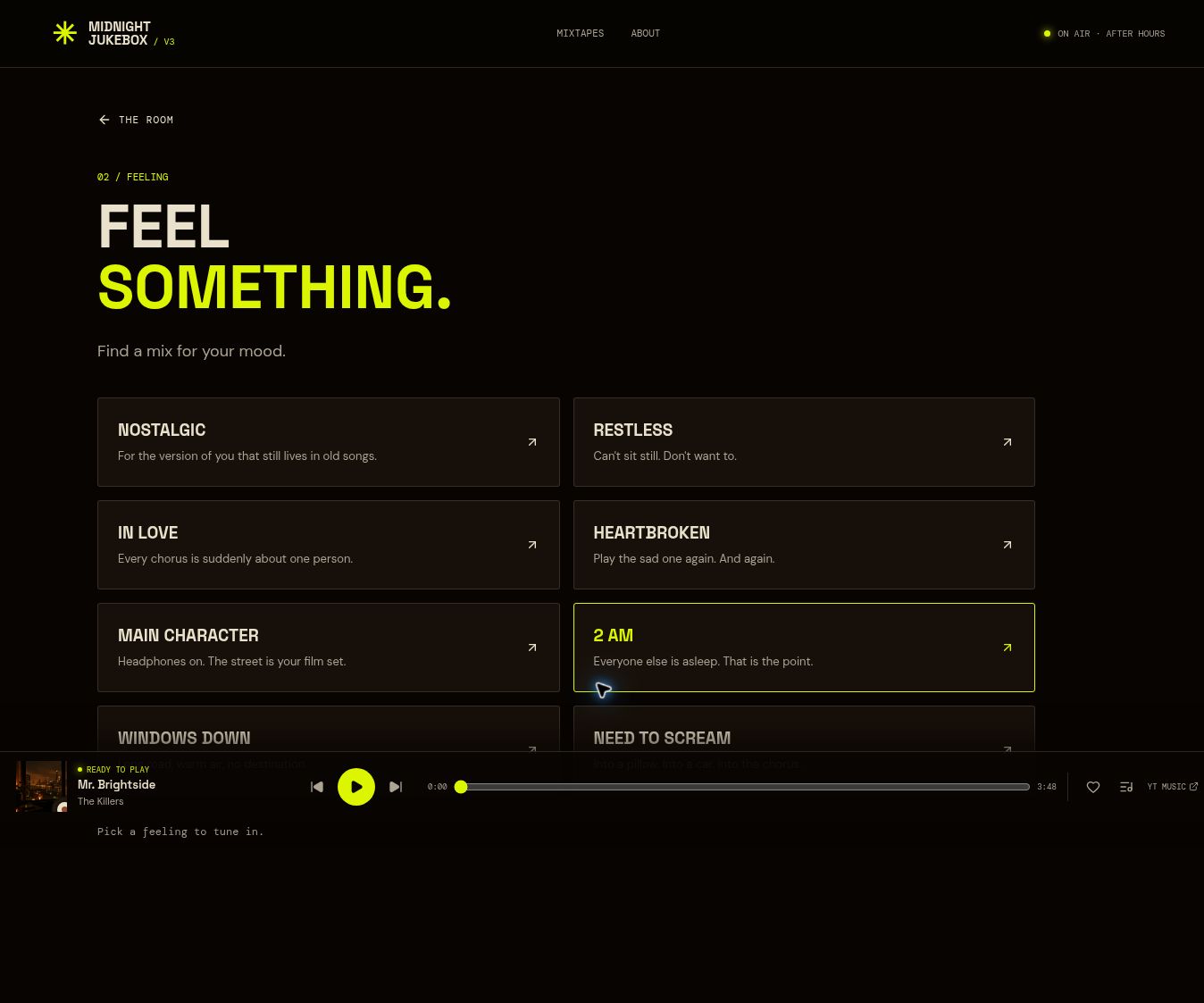
Feel Something offers eight moods: Nostalgic, Restless, In Love, Heartbroken, Main Character, 2 AM, Windows Down, and Need to Scream. Selecting one reveals a corresponding song list on that page.
Surprise Me works directly from the homepage. In the live check, it selected a track and changed the persistent player without navigating to a separate discovery page.
03 / MIXTAPES & CONTINUITY
Make discovery
feel tactile.
The tape shelf
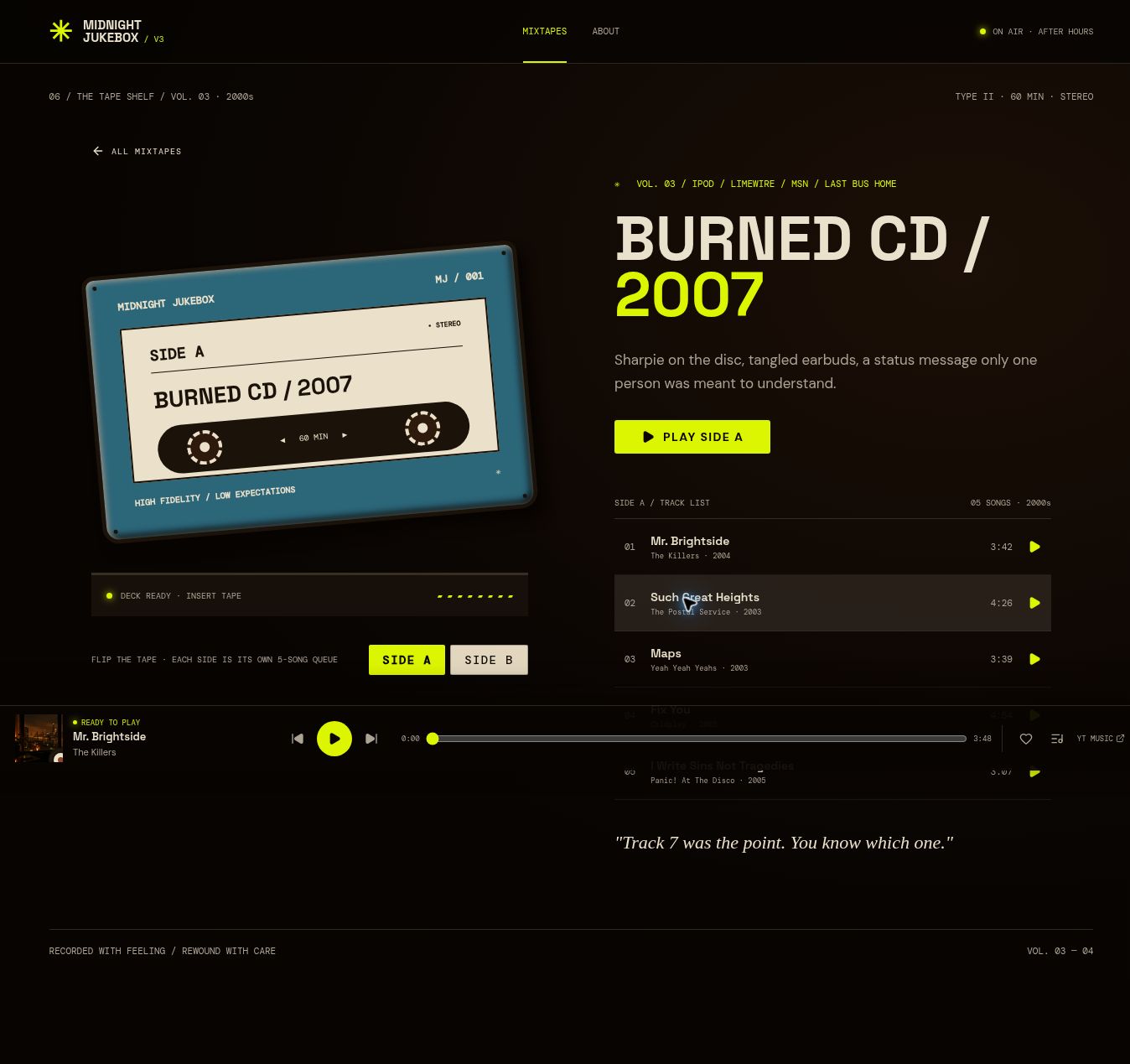
The Mixtapes page contains four cassette-style collections: Neon Drive ’86, After School ’97, Burned CD / 2007, and Last Scroll Before Sunrise. These same collections are featured on the homepage, so listeners can open a tape directly or browse the shelf.
Two sides, one collection
Each mixtape has its own detail page with a short introduction, Side A / Side B selection, a track list, and a Play Side action. The inspected Burned CD tape has five songs on each side. Switching sides changes the displayed list without leaving the page.
A player that stays in place
The bottom player remains present across the inspected homepage, decade, mood, and mixtape routes. It includes track and artist information, previous / play / next controls, seeking, a favorite toggle, an Up Next queue, and a link to YouTube Music.
The iPod as a companion
Decade and mood results also show a Midnight iPod panel with now-playing information and playback controls. It is part of those results pages, rather than a separate navigation destination.
04 / CURRENT INFORMATION ARCHITECTURE
The routes
behind the room.
This map reflects the pages and interactions inspected on the live site. Decade and mood results appear within their respective routes. Surprise Me changes the player from Home. Mixtapes use dedicated collection pages; About is a section of Home.
The shared player connects these journeys. The architecture below distinguishes navigation destinations from selection states and player controls.
Go Back in Time
Choose a decade
1970s → 2020s
Track list · Play · Show all
Midnight iPod panel
Feel Something
Choose one of
eight moods
Track list · Play · Show all
Midnight iPod panel
Surprise Me
Jukebox chooses
a track
Home remains the current page
The Tape Shelf
Four collections
Also featured on Home
Side A / B · Track list
Play side or individual track
Track & artist · Previous / Play / Next · Seek · Favorite · Up Next queue · YouTube Music link
About → Home section #about-midnight. The iPod is a results-page panel; the queue is a player panel.
05 / VISUAL & INTERACTION DESIGN
Atmosphere
with orientation.
The live visual system combines a near-black background, warm room illustration, cream typography, and bright lime accents. Large headlines establish the invitation; thin borders and compact metadata organise the song lists and tape shelf.
Cassettes and the iPod make familiar music objects part of the interaction language. The main paths remain explicit text choices, with a Room link on discovery pages and All Mixtapes on tape details to support returning to the previous context.
Screenshots and this IA were checked against the live site on 6 October 2026. The interaction review confirmed navigation, decade and mood selection, tape-side switching, Surprise Me track selection, and the queue panel. End-to-end audio playback was not verified.
06 / NEXT VALIDATION
Does the invitation
lead to a song?
First action
Can a new visitor choose a discovery route and understand the next step without explanation?
Player continuity
Do the global player, queue, and results-page iPod communicate the same playback state clearly?
Access & reliability
How well do the journeys work on mobile, with keyboard navigation, and when audio takes time to load?
These are proposed validation questions. No user-research findings, adoption figures, or measured impact are claimed.